
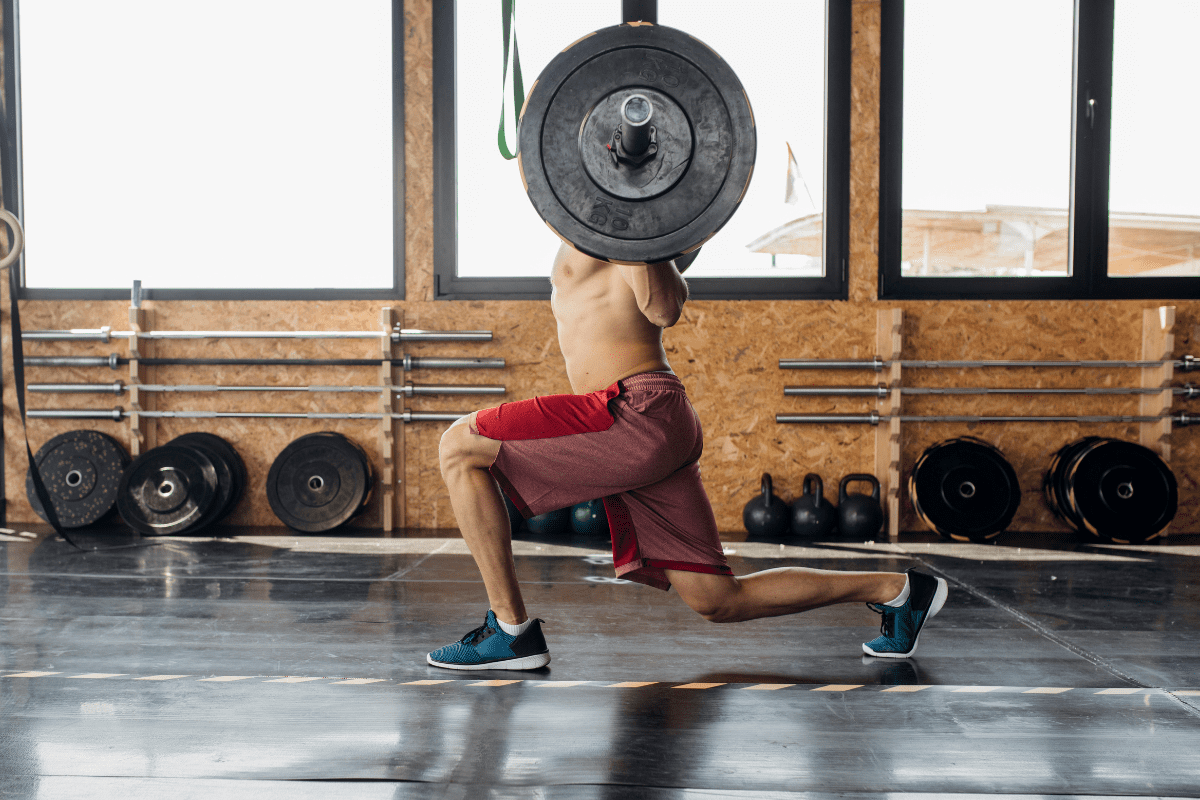
Barbell Lunges (How To, Muscles Worked, Benefits)

The Barbell Lunge is one of the best single-leg movements that one can do in the weight room.
In this guide, I’m going to teach you how to properly do Barbell Lunges, what the benefits are along with a few alternatives in case you need them.
How To Barbell Lunge
Equipment Needed
- Barbell
- Bumper Plates
- Squat Rack (Not completely necessary as you can clean and press a bar onto shoulders if needed, but a rack is going to make this a whole lot easier especially if lifting heavier weight)
Muscles Worked
- Quads
- Hamstrings
- Glutes
- Core (stabilizers)
Instructions
- Unrack the barbell similar to how you would unrack a bar for a back squat.
- Grab the bar with a slightly wider than shoulder-width grip.
- Squeeze the shoulder blades and engage the lats to create a stable shelf to sit the bar on
- Place the bar across the traps, brace the core and remove the bar from the rack by standing tall and then walking back out of the rack.
- Once you’ve created enough room for yourself from the rack you can begin the movement.
- Step forward with one leg, giving yourself enough room to drop into a lunge comfortably without feeling overextended.
- Keep the chest as upright as possible and drop the back knee to roughly one inch from the floor.
- Now drive through the heel and midfoot of the front foot to drive yourself back up tall.
- Repeat on the opposite leg and alternate back and forth until all reps have been completed.
Coaching Points
When you step out, make sure to keep the feet shoulder-width apart. If you’re feeling very off-balance in your lunge there is a good chance that you are stepping the lead foot directly in front of the back foot (essentially placing yourself on a tight rope).
Keep the front foot flat on the floor when in the lunge position. One of the most common mistakes is raising up onto the ball of the front foot. One of the reasons for this is often the next most common mistake that I see with Barbell Lunges…
Make sure to take a big enough step. Often times I see athletes take way too small of a step. This leads to lunge being extremely cramped and can lead to a whole host of other issues.
Benefits of Barbell Lunges
Single Leg Movements like Barbell Lunges are an extremely important addition to any athlete’s workout regimen, regardless of sport.
Many (if not most) athletic movements are often done on one leg. This includes sprinting, jumping and cutting.
Single Leg Exercises help improve leg strength, balance, stability and also show any strength imbalances the lifter may have from one side to the other. Single Leg Exercises can also be part of the solution if and when an asymmetry is found.
Barbell Lunge Alternatives
If you can’t do Barbell Lunges, for whatever reason, here are a few alternatives that you may be able to try out.
Need more options? Here are 9 of my favorite alternatives for Barbell Lunges.
DB Lunges

Don’t have a barbell? Or maybe you’re not able to axial load (place weight on your shoulders like a back squat). You may be able to try DB Lunges instead.
DB Lunges is the exact same movement but involves holding dumbbells in each hand versus using a barbell. You’ll get virtually all of the same benefits of the Barbell Lunge.
The only drawback to DB Lunges is it’s harder to use the same type of weight because grip will start to become a limiting factor for most lifters. But, other than that they’re a great lift that I’ll use on their own (not just as an alternative to Barbell Lunges)
Barbell Step-Ups
If Lunges are uncomfortable for you, then Barbell Step-Ups may be a good single-leg replacement.
Some athletes find that Lunges, even with proper form, to be hard on their knees. Sometimes, Reverse Lunges may be a solution, but other times I’ll just have them switch to Barbell Step-Ups.
It’s still a great exercise to get in the needed single leg work, but without the same amount of stress placed on the knees.
Pistol Squat
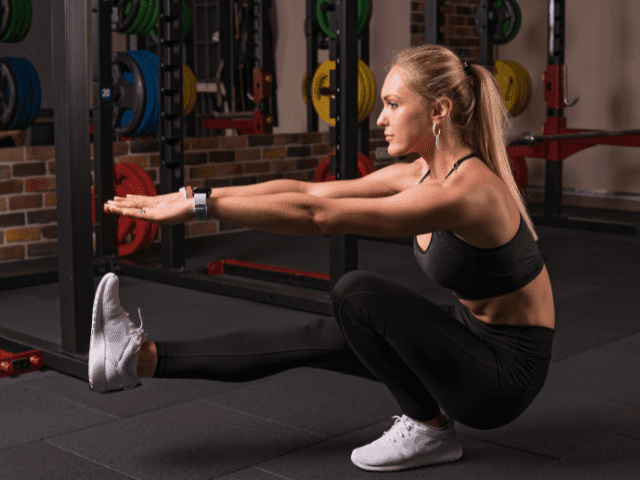
Another good single-leg alternative for Barbell Lunges – that doesn’t require any equipment at all – is the Pistol Squat.
If you’re really good at them you literally need no equipment at all, but at most you’ll only need a box or chair to sit down to.
More Links and Info
Looking for more Lower Body Lifts? Check out the Exercise Library where there is a growing collection of exercises with step-by-step instructions.
