
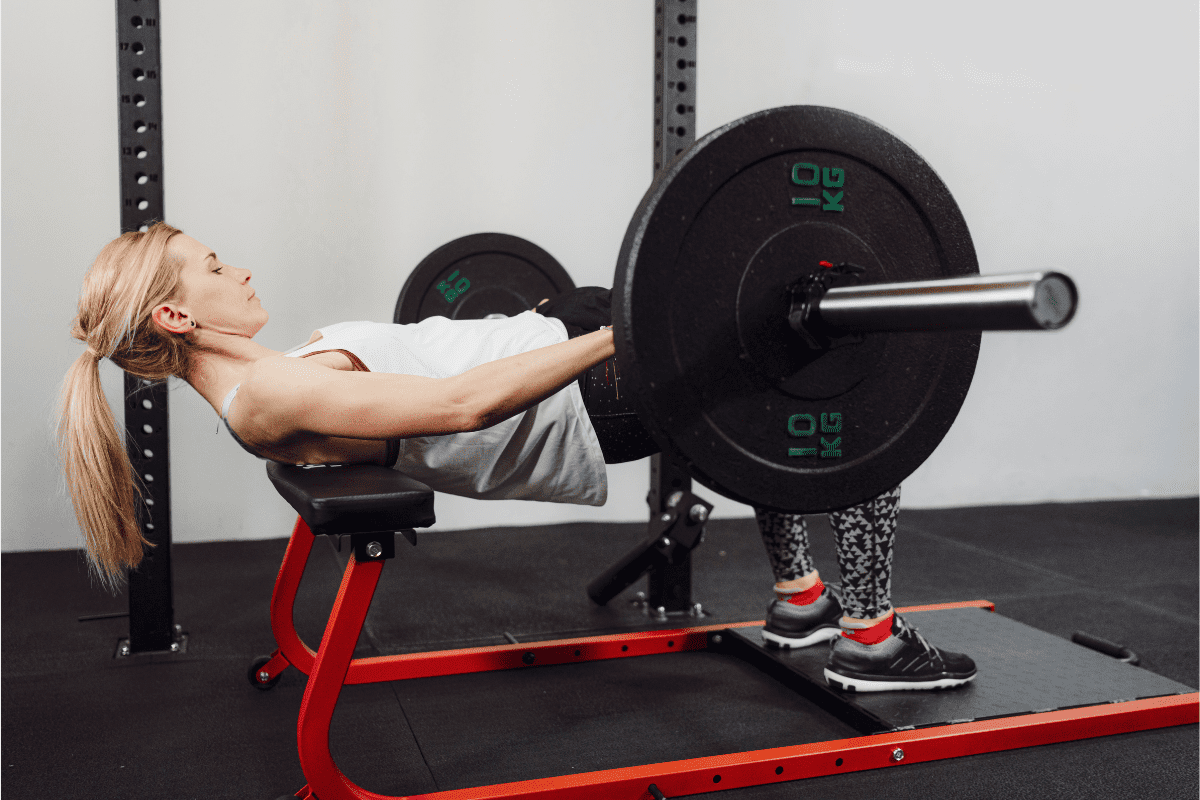
Hip Thrusts (How To, Muscles Worked, Benefits)

Hip thrusts are a powerful exercise that can help to build strength and muscle in the glutes, hips, and thighs. Basically, Hip Thrusts are an advanced version of a Glute Bridge where weight, typically in the form of a barbell, is used to add resistance to the hip extension.
In this guide, I’m going to teach you how to do Hip Thrusts. I’ll also include important coaching points, muscles worked and a few alternatives as well.
This article contains affiliate links. If you buy something using these links I may earn a commission.
How To Do Hip Thrusts
Equipment Needed
- Bench Press (or another stable object like a plyo box)
- Barbell or Dumbbell
Muscles Worked
- Glutes
- Hamstrings
- Abdominals (as a stabilizer)
How To
- Start by sitting on the ground with your feet flat on the floor and your upper back resting on a bench or other stable surface.
- Hold a weight, such as a barbell or a dumbbell, across your hips.
- Engage your core and glute muscles, and push through your heels to lift your hips off the ground until your body forms a straight line from your shoulders to your knees.
- Hold for a moment at the top of the movement, then slowly lower your hips back down to the starting position.
- Repeat for the desired number of reps.
Coaching Points
If holding a barbell across your hips is uncomfortable, try using a folded-up yoga mat, towel or an Airex Pad. These are all viable options to use as padding to make the exercise more comfortable.
Benefits of Hip Thrusts
Some of the potential benefits of this exercise include:
- It can improve overall strength and power. Hip thrusts require the use of large, explosive movements, which can help to increase strength and power in the hips, glutes, and thighs.
- Hip thrusts require the engagement of the core muscles to maintain proper form, which can help to improve posture and core stability.
- Hip thrusts are a highly effective exercise for targeting the glutes.
How Many Reps?
Hip Thrusts are a supplemental strength exercise. Recommended rep ranges are 3 to 4 sets of 8 to 12 reps each set.
Hip Thrust Alternatives
Need an alternative for Hip Thrusts? Here are a couple of exercises that you may be able to use as a substitute.
Want more options? Here are 12 quality Hip Thrusts alternatives to choose from.
Glute Bridges

Glute Bridges are essentially the bodyweight version of Hip Thrusts. They can be done with the shoulders up on a bench, or with them on the floor.
The movement itself is exactly the same. Focus on driving the hips up and squeezing the glutes at the top.
Kettlebell Swings

Kettlebell Swings are another exercise that emphasizes hip extension but from a standing position. Brace the core, hinge at the hips and drive the kettlebell by explosively extending the hips.
If you want an alternative that is a bit more explosive or you simply find Hip Thrusts uncomfortable to do, Kettlebell Swings are a very close substitution that can take its place. For more info, check out my direct comparison of Kettlebell Swings vs Hip Thrusts.
More Links and Info
Need a training program? The Horton Barbell Shop contains a wide variety of programs from Sports Performance Programs to Beach Ready Programs. So, whether you’re looking to improve in your sport, just want to look good at the beach or anything in between – we have a program for you!
If you’d like to see more exercises for developing a strong lower body, check out the Lower Body Lifts section of our Exercise Library. There you’ll find dozens of movements, all with complete step-by-step instructions.
