
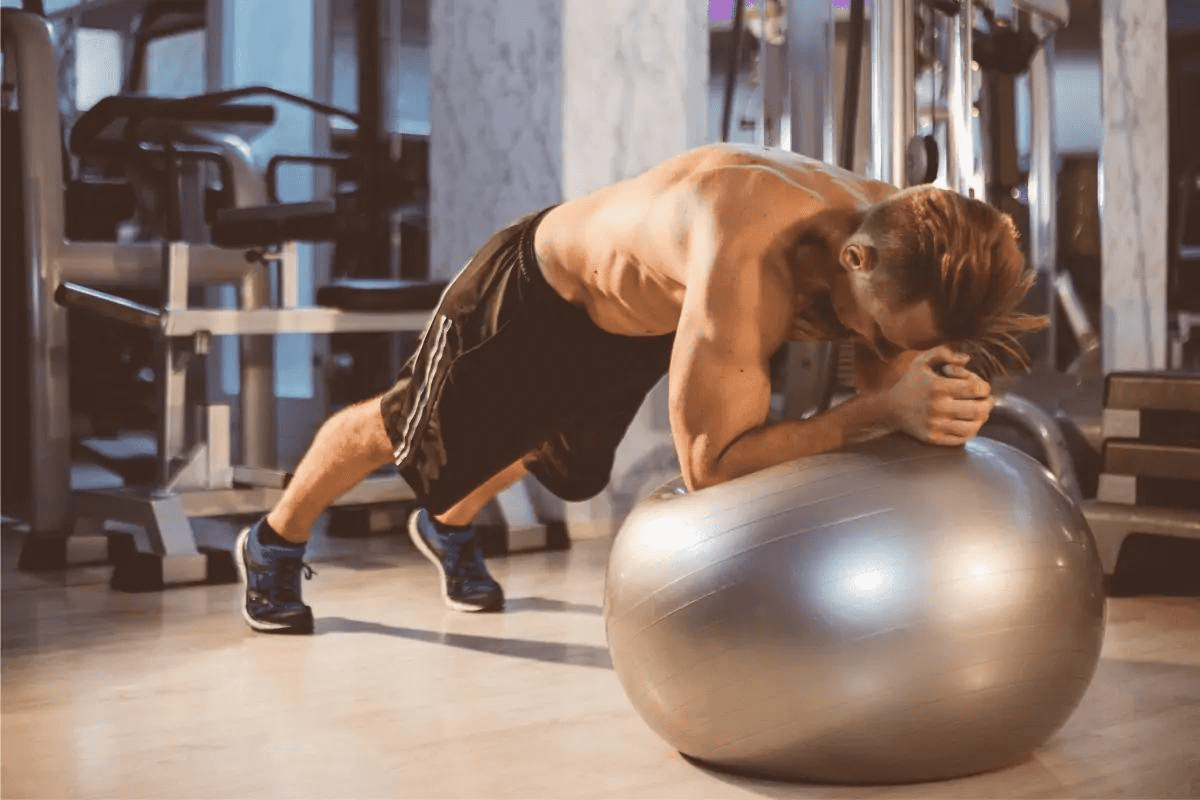
Stability Ball Body Saw (How To, Benefits, Muscles Worked)

If you’re looking for a challenging and effective exercise to improve your core strength, stability, and balance, the Stability Ball Body Waw is a great option.
This exercise combines the benefits of a plank with the instability of a stability ball, creating a dynamic movement that engages multiple muscle groups at once. In addition to your core, the sawing motion of the exercise also hits your shoulders and chest, making it a versatile movement to add to your next core workout.
In this guide, I will teach you how to do a Stability Ball Body Saw including important coaching tips. I’ll also discuss the benefits of the exercises and provide you with a few alternatives in case you need them.
How To Do Stability Ball Body Saw
Equipment Needed
- Stability Ball
Step-by-Step Instructions
- Place a stability ball on the ground and kneel in front of it.
- Place your forearms on top of the ball with your elbows directly below your shoulders and your hands clasped together.
- Extend your legs behind you and balance on your toes, creating a straight line from your head to your heels.
- Using your forearms, push the ball forward and backward, as if you were sawing back and forth.
- Be sure to maintain your plank position and avoid letting your hips sag or lift too high.
- Repeat the sawing motion for the desired number of reps or time.
- When you’ve finished the set, drop your knees down to the ground first (for balance) before trying to stand.
Coaching Points
The Body Saw does not need to be a big range of motion. About a 12-inch range of motion from front to back is more than enough to get the desired effect from the exercise.
Trying to overdo it could cause you to lose your position and fall off one side of the ball.
Benefits of Stability Ball Body Saw
The sawing motion of Body Saws targets your core muscles, including your abs, obliques, and lower back. Done consistently this can lead to increased core strength and stability.
The instability of the stability ball requires you to engage your core muscles and shoulder stabilizers to maintain your balance. This can improve your overall balance and coordination along with improved core and shoulder stability.
Adding Stability Ball Body Saws to your core workout can add some variety and keep your workouts from getting boring doing the same sets of crunches every time.
Stability Ball Body Saw Alternatives
Need an alternative for Stability Ball Body Saws? Whether you don’t have a stability ball or you just want something a little different, here are a few exercises that you may be able to use as a replacement.
Stir The Pot
Honestly, Stir the Pot is probably more of a variation than it is an outright alternative. Stir the Pot is a very similar exercise also done on a stability ball from a plank position.
Instead of simply going back and forth, Stir The Pot has the lifter move their forearms in a circular fashion. In my opinion, this is a bit more challenging and a great alternative for someone who wants a little extra difficulty.
Shoulder Taps
Shoulder Taps are another plank variation, but one that doesn’t need a stability ball.
Shoulder Taps involve holding a push-up plank position and then simply tapping the opposite shoulder with the opposite hand. Alternating back and forth while maintaining a plank position improves both core and shoulder stability.
More Links and Info
Need a training program? The Horton Barbell Shop contains a wide variety of programs from Sports Performance Programs to Beach Ready Programs. So, whether you’re looking to improve in your sport, just want to look good at the beach or anything in between – we have a program for you!
If you’d like to check out more core exercises, then head over to the Core section of our Exercise Library. There you’ll find dozens of movements, all with complete detailed instructions.
