

How Strength Training Improves Speed (Really)

If you still think lifting weights makes athletes slower, you’re stuck in the wrong decade.
Some of the strongest athletes I’ve coached weren’t just weight room warriors — many were the fastest players on the field. And that’s not a coincidence.
Strength training, when done right, builds the foundation for speed. It doesn’t replace sprint work, but it amplifies it. You can’t create more force into the ground without stronger legs. You can’t sprint efficiently without trunk control. You can’t produce power without a base of strength.
Simply put, speed is how much force you can apply and how fast you can apply it.
The Role of Force in Sprinting
Every sprint is a battle against the ground. The faster and harder you push, the farther and faster you go.
This is where strength comes in.
When you sprint, you’re applying force into the ground to propel your body forward. If you don’t apply much force, your stride is short and your speed is limited. But when you can produce high levels of force — especially horizontally — you cover more ground with each step and accelerate faster.
It’s no different than jumping. You don’t jump higher by being more “quick” — you jump higher by producing more force in less time. Sprinting is just repeated horizontal jumps.
This is why building strength, especially in the lower body and trunk, directly increases your speed potential. You’re giving your body the horsepower it needs to move faster.
Key Strength Qualities That Improve Speed
Not all strength is equal when it comes to getting faster. These are the four strength qualities that matter most:
1. Max Strength
This is your raw horsepower.
The more force your muscles can produce, the more power you can potentially apply into the ground. This is especially important in your glutes, hamstrings, and posterior chain.
Trap Bar Deadlifts, Front Squats, and heavy RDLs are some of the best tools here. Build a strong base first, then learn how to apply it fast.
2. Rate of Force Development (Power)
It’s not just how much force you can produce — it’s how quickly you can produce it.
That’s what separates strong lifters from explosive athletes. Olympic lifts (Power Cleans, Snatch Pulls), med ball throws, and loaded jumps train your nervous system to fire fast and apply strength with speed.
3. Eccentric Strength
When you sprint, you don’t just produce force — you absorb it too. Eccentric strength helps you decelerate, absorb impact, and transition into the next stride.
Exercises like Nordic curls, tempo squats, and controlled RDLs strengthen your ability to absorb force and stay in control at high speeds.
RELATED: Why Slowing Down Your Reps Can Speed Up Your Results
4. Trunk Strength
If your core is soft, power leaks out.
Strong legs don’t matter if your midsection can’t transfer the force.
Carries, anti-rotation work, and isometric holds build the kind of trunk strength that keeps your torso stable while your legs generate power.
Lifts That Transfer Best to Sprinting
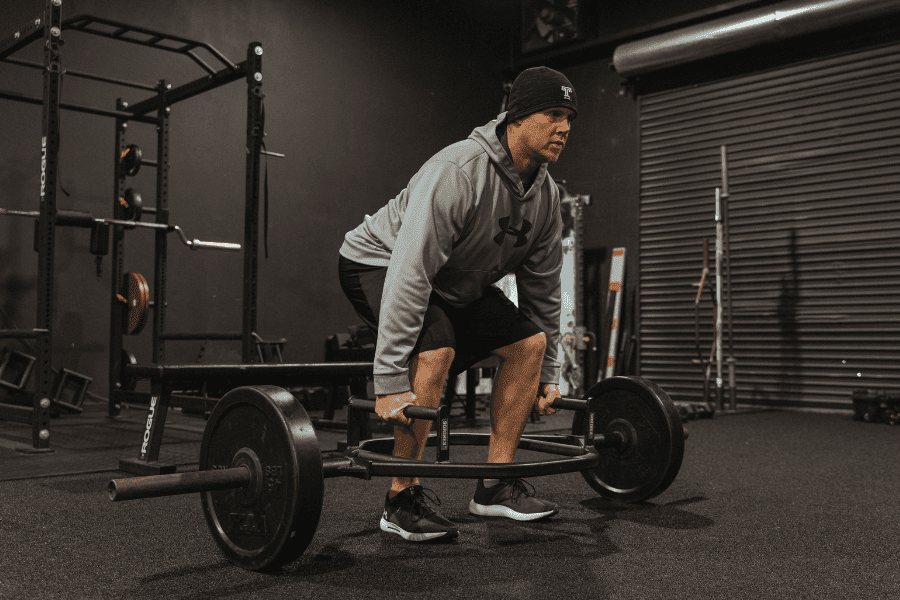
Here’s what I program most often when the goal is speed:
- Trap Bar Deadlift – Builds posterior chain strength with a more sprint-friendly position than a traditional deadlift.
- Front Squat – Teaches force production with posture and control.
- Romanian Deadlift (RDL) – Reinforces hamstring tension and hip hinge mechanics.
- Power Clean / Hang Clean – Builds speed-strength and teaches triple extension.
- Sled Pushes – Mimic the forward lean and force application of sprinting.
- Med Ball Throws (Vertical Throw, Chest Pass) – Build rotational and linear power with speed.
- Weighted Jumps (Trap Bar or DB) – Train power and ground contact with minimal complexity.
- Farmer’s Carries – Improve trunk stability and force transfer under load.
If an exercise builds force, reinforces posture, or teaches the body to move fast — it helps sprint speed.
How to Program Strength Work Without Hurting Sprint Work
Lifting and sprinting can absolutely work together — but the order, intensity, and recovery matter.
Here’s how to make them complement each other instead of clash:
1. Sprint First, Then Lift
Always sprint when you’re fresh. Sprinting with pre-fatigued legs is a great way to reinforce bad mechanics or worse, get injured. Get your speed work in early, then hit the weight room.
2. Match Your Lifting to Your Speed Goals
If you’re trying to improve sprinting, don’t lift like a bodybuilder. Choose lifts that build force and power — not just muscle size. Keep reps low, focus on bar speed, and train with intent.
3. Control Volume and Fatigue
Avoid stacking heavy squats or deadlifts the day before sprint-intensive sessions. If you’re constantly sore, your speed work suffers. Prioritize quality movement, not just crushing volume.
4. Prioritize Bar Speed on Lifts
If the bar is moving slow, you’re not training for speed. When the goal is force application and explosiveness, every rep should move like it matters — especially in your Olympic and lower body lifts.
5. Build in Recovery
Speed work is neural. Strength work is too. That means your central nervous system needs time to recover. Don’t treat these sessions like cardio — treat them like skill work.
Final Takeaway: Stronger = Faster (When Trained Right)
If you want to sprint faster, you need to be stronger. Period.
Not “gym strong.” Field strong. Sprint strong. The kind of strong that helps you put more force into the ground, with better posture, and more speed out of every stride.
Strength doesn’t replace sprinting — but it lays the foundation for it.
So stop fearing the weight room. Use it. Program it with purpose. And train in a way that builds real speed, not just soreness.
Want to get faster?
Start getting stronger — the right way.
