

Ring Dips (How To, Muscles Worked, Benefits)

The Ring Dip is an advanced bodyweight pressing exercise that builds strength and stability in the chest, shoulders, and triceps. Performed on gymnastic rings, it challenges your core and shoulder stabilizers far more than standard dips, developing total upper-body control and pressing power.
It’s a key movement for gymnasts, CrossFit athletes, and anyone looking to build functional upper-body strength.
Primary Muscles Worked: Pectoralis Major (Chest), Triceps, Anterior Deltoids (Front Shoulders)
Secondary Muscles Worked: Core, Lats, Forearms, Scapular Stabilizers
Equipment Needed: Gymnastic Rings
How To Do Ring Dips
Step-by-Step Instructions
- Set-Up:
- Adjust the rings so they hang just below chest height.
- Grip the rings firmly and jump or step up to support yourself above them with arms fully extended and rings close to your sides.
- Keep your body upright or with a slight forward lean, legs straight or crossed behind you.
- Execution:
- Lower yourself slowly by bending your elbows and allowing your body to descend between the rings.
- Keep your elbows close to your sides and shoulders slightly externally rotated (rings turned out a bit).
- Descend until your shoulders are just below your elbows or your upper arms are parallel to the ground.
- Press yourself back up to full extension, keeping the rings close and your body stable.
- Tips for Proper Form:
- Keep your core tight, avoid swinging or letting your legs move.
- Maintain control of the rings throughout; don’t let them drift outward.
- Turn the rings slightly outward at the top of the rep for shoulder stability.
- Move slowly and deliberately, this is a stability-driven exercise.
Key Benefits
- Builds pressing strength and muscle in the chest, shoulders, and triceps.
- Improves balance, control, and coordination through instability.
- Strengthens the core and scapular stabilizers.
- Great for progressing toward advanced ring skills (like muscle-ups).
Modifications and Variations
- Easier Option:
- Perform dips on parallel bars or a dip station for more stability.
- Use resistance bands for assistance under the knees or feet.
- Lower only halfway until you build more strength and control.
- Harder Option:
- Add a weighted vest or belt.
- Pause at the bottom or perform slow eccentric (lowering) reps.
- Perform Ring Turn-Out Dips (rings rotated out at the top for more challenge).
Common Mistakes
- Flaring Elbows: Keep elbows close to your sides to protect the shoulders.
- Letting Rings Drift Out: Maintain control and stability throughout the movement.
- Arching the Lower Back: Engage your core to keep a solid body line.
- Rushing Reps: Move with control, especially on the descent.
Reps and Sets Recommendations
- For Strength: 4–5 sets of 4–6 controlled reps.
- For Hypertrophy: 3–4 sets of 8–10 reps.
- For Skill and Stability: 2–3 sets of 5–8 slow, precise reps focusing on control.
Ring Dip Variations
Dips, similar to Pull-Ups, are not easy for a beginner. On the flip side, advanced lifters may get to a point where even sets of 25 dips start to not be challenging enough. Here are a few variations for both sides of this spectrum.
(Need some alternatives for Ring Dips? Here are some of my favorite Ring Dip Alternatives.)
Bench Dips

Another alternative for Dips, if you’re struggling (or if you don’t have a Dip Attachment), is Bench Dips.
Use a bench (or a sturdy box), place the heels of your hands on the edge of one side of the bench and extend your legs straight out in front of you.
Start with your arms extending and then lower yourself down until your triceps become parallel to the floor. When you reach the bottom of the rep, drive yourself back to the starting position. Make sure to keep your back close to the bench throughout.
Dips

If you have a dip attachment for your rack or a standalone dip station, Dips are a slightly easier version of Ring Dips that are still extremely effective.
They’re easier because a dip attachment is more stable and thus requires less balancing while doing reps. If you’re not quite ready for Ring Dips yet, but Bench Dips are way too easy – Dips should be the next progression in your development.
Weighted Dips
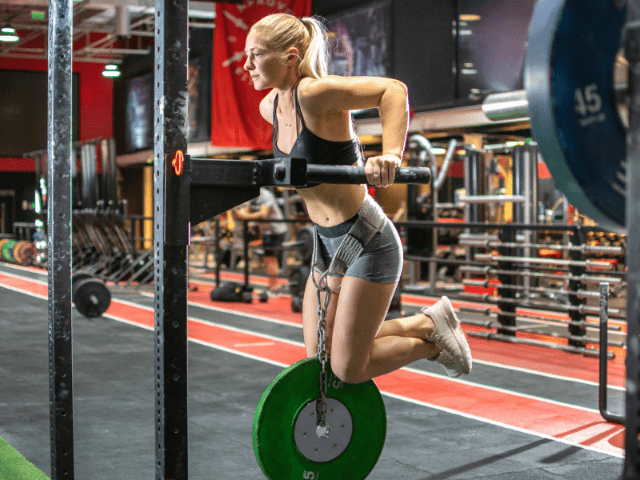
If you don’t have rings and Dips have lost some of their challenge then it may be time to progress to Weighted Dips. There are many different ways you can add extra resistance to your Dips (Weighted Vest, Chains, etc). Choose whichever implement you have access to and are comfortable using.
Some examples are a weighted vest, squat/bench chains, holding a dumbbell between your feet or using a weight belt with a chain designed to hold weight plates.

Get Shredded… For Free
Get a free workout Monday through Friday, posted right here on Horton Barbell. These workouts are designed to help you get strong, in shape and look great at the beach!
More Links and Info
For more great exercises focusing on the biceps and triceps, check out the Arm Farm section of the Exercise Library.
