
Copenhagen Planks (How To, Muscles Worked, Benefits)

The Copenhagen Plank is an advanced core and hip exercise that targets the adductors (inner thigh muscles) while also strengthening the obliques and deep stabilizers of the trunk and hips. It’s performed as a side plank variation, but with your top leg supported on a bench or box, forcing the inner thigh of that leg to hold much of your body weight.
This is one of the most effective movements for improving hip stability, groin strength, and injury prevention.
Primary Muscles Worked: Adductors (Inner Thigh), Obliques, Core
Secondary Muscles Worked: Glutes, Shoulders, Quadratus Lumborum, Hip Flexors
Equipment Needed: Bench, Box, or Step
How To Do Copenhagen Plank
Step-by-Step Instructions
- Set-Up:
- Lie on your side next to a bench or sturdy box.
- Prop yourself up on your bottom forearm, elbow directly under your shoulder.
- Place your top leg on the bench so the inside of your ankle or calf rest on the edge (the further toward your foot, the more challenging).
- Your bottom leg can either hang freely underneath with the knee lifted in front or stay lightly supported on the floor (depending on your progression).
- Execution:
- Engage your core and lift your hips off the ground until your body forms a straight line from head to foot.
- Keep your top leg pressed into the bench and squeeze your inner thigh (adductors) to hold the position.
- Maintain a neutral spine and keep your shoulders and hips stacked.
- Hold for the prescribed time, then switch sides.
- Tips for Proper Form:
- Keep your head in line with your spine, don’t let it drop forward.
- Squeeze your glutes and brace your abs to stay rigid.
- Control your breathing, inhale through the nose, exhale through the mouth.
- Don’t let your hips sag; maintain a straight line from shoulder to knee.
Key Benefits
- Strengthens the adductors and deep core stabilizers.
- Improves hip stability and control, reducing the risk of groin strains.
- Builds functional strength for change-of-direction and lateral movements.
- Enhances balance and coordination between the core and lower body.
Modifications and Variations
- Easier Option:
- Support your lower leg on the ground (Short-Lever Copenhagen Plank) instead of letting it hang.
- Perform a Knee-Supported Copenhagen Plank, resting your top knee (not ankle) on the bench.
- Harder Option:
- Perform Dynamic Copenhagen Planks by lowering and raising your hips in small pulses.
- Hold the bottom leg off the ground for the full duration.
- Add time under tension (longer holds or slow lowering phases).
Common Mistakes
- Sagging Hips: Keep your hips lifted to maintain alignment and engage the adductors properly.
- Shoulder Misalignment: Stack your shoulder directly over your elbow for stability.
- Holding Breath: Keep steady, controlled breathing throughout the hold.
- Overarching or Twisting the Back: Stay rigid and square, avoid rotating through the spine.
Reps and Sets Recommendations
- For Strength/Stability: 3–4 sets of 20–30 second holds per side.
- For Endurance/Prehab: 2–3 sets of 30–45 second holds per side.
- For Progression Work: 2–3 sets of 8–10 dynamic reps (lifting/lowering hips).
Copenhagen Plank Alternatives
Need an alternative for Copenhagen Planks? Here are a few exercises that you may be able to use as a substitute.
Want more options? Here are my 5 favorite alternatives for Copenhagen Planks.
Monster Steps
Monster Steps received their name because Banded Adduction Steps didn’t really roll off the tongue.
Take a band and loop it around the bottom of a rack. Loop the opposite end around your ankle and step away from the rack just enough to create tension in the band. You should be facing perpendicular to the rack with your feet slightly wider than shoulder width. (The band tension should be pulling laterally away from the body)
Now, pull the foot into a hip-width position and then CONTROL IT back to the starting position.
Medicine Ball Straight Leg Lifts
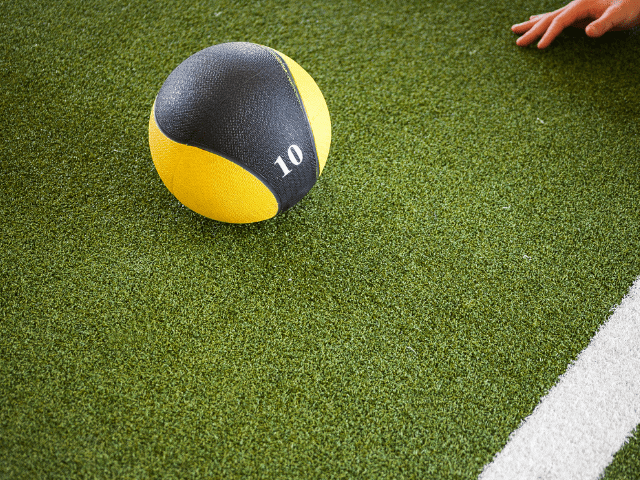
Medicine Ball Straight Leg Lifts are another exercise that simultaneously works the core and the groin.
By squeezing a medicine ball between the feet, you force the groin to actively fire to control the medicine ball and keep it in place. It is one of those deceptively challenging exercises that you’ll know immediately right where it’s working.
Side Planks
Side Planks are a Copenhagen Plank without the added groin element.
However, if you want to add a groin element to it, you can raise the down leg knee up in front of you as you side plank. This can make a great alternative if you don’t have a bench to elevate your foot onto. Or, as a more beginner-friendly version before progressing on to the more advanced elevated position.
Online Strength Programs
- 1-on-1 Online Coaching
- Sports Performance Programs for Football, Basketball, Soccer & More
- Programs for Former Athletes (Legends) Who Still Want to Train Like Athletes
- Programs for Adults Who Want to Get Healthy (and look great at the beach!)
- Use Code “HB10” to Get 10% Off Today
More Links and Info
If you’d like to see more warm-up drills and exercises, make sure to check out the Warm-up Section of our Exercise Library. There you’ll find dozens of warm-up movements, all with step-by-step instructions.
